
Handling Heavy Window Frames with Fewer Operators: How to Optimize Jobsite Glazing Safely
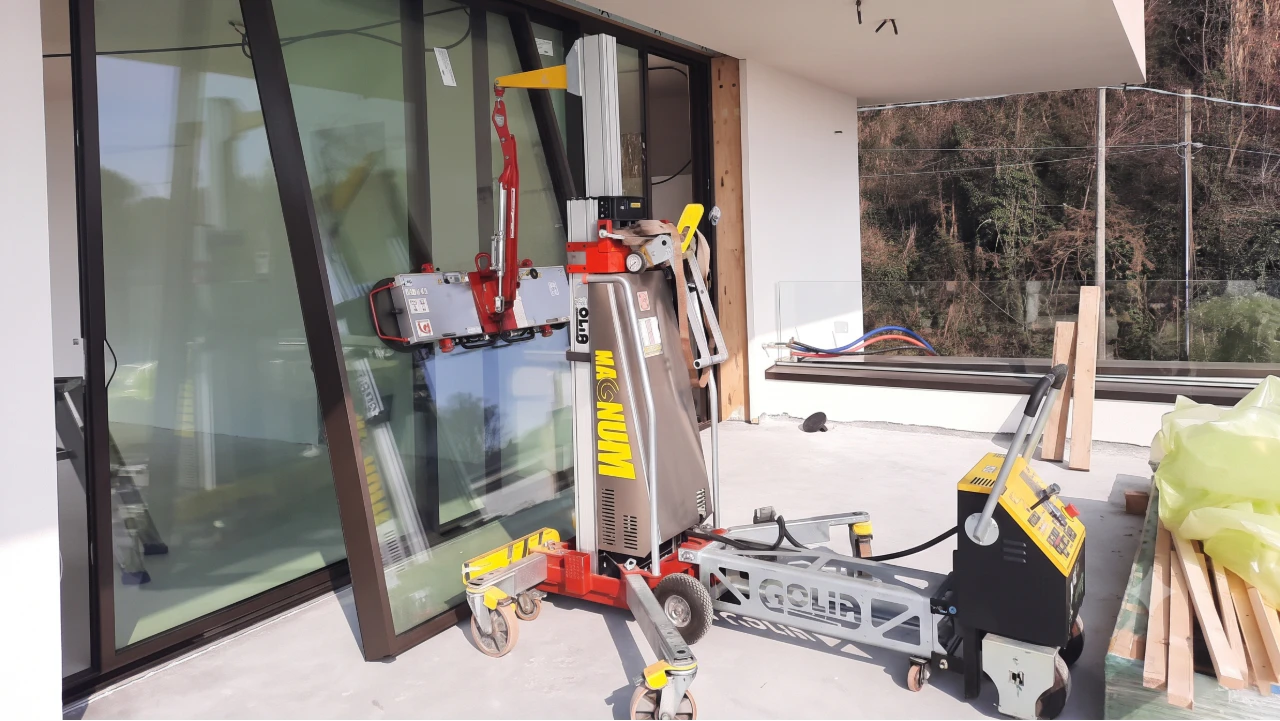
Architectural demands are pushing toward large spans, minimal sightlines, and massive glazed surfaces. Triple-pane glass with high acoustic and thermal performance is now standard, pushing element weights past 200, 300, or even 500 kg. While visually striking, these heavy units present serious operational challenges on site. The core dilemma for window installers is clear: how to maneuver and install these oversized elements safely while protecting project profit margins. Relying on brute force by adding extra hands is no longer sustainable due to labor costs, ergonomic health risks, and stringent jobsite safety regulations.
The Bottleneck of Traditional Glazing Methods Site installation costs now represent a major share of the total project budget. Previously, handling an oversized lift-and-slide door meant calling in extra technicians to carry the unit manually up stairwells, through tight corridors, or across rough terrain.
This traditional approach introduces three major bottlenecks:
Resource Allocation: Tying up four or five skilled technicians on a single task paralyzes scheduling for other projects during a widespread labor shortage.
Safety and Injury Risks: Manual material handling regulations strictly limit lifting weights per worker. Overexertion causes musculoskeletal disorders, injuries, and operational downtime, while fatigue during final placement risks breaking costly insulated glass units or damaging finished frames.
Logistical Constraints: Urban renovation sites and high-rise apartments feature narrow doorways, small elevators, or finished floors that prohibit heavy cranes or external telehandlers.
From Large Crews to Mechanized Lifting The objective for professional installation teams is to decouple lifting capacity from crew size. Transitioning to compact, mechanized lifting systems allows the frame weight to be transferred entirely to dedicated machinery. Consequently, installation crews can be reduced to one or two operators whose role shifts from physical lifting to guiding the load with millimeter precision onto the subframe. Effective site lifts must pass through standard internal doors without disassembly, be easily loaded/unloaded by a single operator, and offer micro-adjustments for tilting, rotating, and centering.
Engineering Efficiency: The Golia Approach Golia material lifts (designed and manufactured in Italy by Femak) overcome traditional equipment limitations through targeted engineering innovations:
Cordless Drill Drive System: Instead of heavy integrated electric motors or bulky hydraulics, models like the Golia Bull utilize a patented mechanism powered by a standard cordless drill/driver. This significantly reduces total equipment weight while maintaining lifting capacities up to 500 kg and reaches approaching 4 meters.
Confined Space Navigation: Moving tall glass panes vertically through narrow corridors (<80 cm) is simplified in models like the Golia Junior via a 360° rotating mast. Glass can be loaded, rotated parallel to the chassis, and wheeled through standard doorways without unloading or physical strain.
Precision Vacuum Glass Attachments: Integrated continuous-vacuum suction systems featuring 360° rotation and tilting allow two operators to extract glass from transport A-frames, navigate tight paths, and adjust positioning effortlessly during final glazing.
Calculating ROI: Economic Benefits of Reduced Crew Sizes Consider installing two large 300 kg lift-and-slide doors. Traditional manual handling often demands a large crew solely for transport and positioning. Utilizing professional lifts like the Golia Evo or Golia Bull enables two installers to complete the same task in under two hours (4 man-hours total). The resulting labor savings lower direct costs and free up personnel to work concurrently on other job sites, increasing total daily operational capacity.