How to Choose a Professional Manual Material Lift
Choosing a professional manual material lift means finding a machine capable of simplifying daily work, increasing jobsite safety, and reducing operator fatigue during lifting, transport, and positioning operations. Whether installing air conditioners, boilers, awnings, pergolas, glass panes, windows, or moving goods in workshop and industrial environments, a manual material lift must be selected based on precise criteria: load capacity, lifting height, stability, footprint, maneuverability, and build quality. In this guide, we look at the key factors to evaluate before purchasing and why relying on a Golia material lift can make a difference in professional applications.
What is a Professional Manual Material Lift? A professional manual material lift is equipment designed to lift, move, and position loads in a controlled manner, without necessarily relying on forklifts, cranes, or more complex lifting systems.
Unlike a standard transport trolley, a manual material lift is engineered to support the operator through every phase of the job: load handling, positioning approach, high-reach lifting, and final placement.
It is an ideal solution when working in confined spaces, indoor environments, small jobsites, or contexts requiring a compact, stable, and easily transportable unit. Under these conditions, jobsite safety becomes paramount: having the right equipment allows the operator to handle loads with greater control, minimizing unnecessary exertion, hazardous movements, and instability during lifting and positioning.
Why Choose a Manual Material Lift Instead of Bulkier Equipment? In many professional projects, using heavy equipment is not always feasible or cost-effective.
A manual material lift allows you to work with greater agility, especially when site access is restricted or when loads must be maneuvered inside buildings, residential homes, retail spaces, warehouses, or technical rooms. Selecting a professional manual lift allows you to:
Reduce operator physical strain;
Enhance safety during lifting;
Speed up installation and positioning tasks;
Work efficiently in narrow or hard-to-reach areas;
Transport the equipment with ease;
Avoid, in many cases, the use of more expensive or cumbersome machinery.
For these reasons, manual material lifts are now widely used by HVAC installers, window fitters, thermal-hydraulic technicians, light construction operators, maintenance specialists, and material handling professionals.
Key Criteria for Choosing the Right Manual Material Lift Selecting a material lift should never be based solely on price. Professional equipment must be evaluated according to the type of work to be performed, the load to be lifted, and the operating conditions involved.
Maximum Load Capacity The first factor to consider is the maximum load capacity—the maximum weight the lift can safely elevate. For light to medium applications, such as moving small equipment, goods, or technical components, a compact model may suffice. For heavier tasks, such as installing glass panes, windows, or heavy elements, it is essential to choose a lift with an adequate payload capacity and a structure designed to ensure stability, even with cantilevered loads.
Undersizing the load capacity is one of the most common mistakes: an inadequate lift can make the job more difficult, less secure, and less precise. At the same time, choosing a machine far larger than necessary may not be optimal either. An oversized lift requires a higher financial investment and can prove less practical logistically, as higher-capacity models carry greater weight to ensure stability and safety.
Clients should ask themselves: What is the weight of the loads I handle most frequently in conditions where heavy machinery cannot enter, but which I can manage with this lift? The correct choice should be guided by routine daily operations, rather than occasional, extreme scenarios.
Maximum Lifting Height Another essential criterion is the maximum height achievable. The lift must allow the load to reach the required height smoothly without strain or compromise to stability.
When installing air conditioning units, awnings, pergolas, or boilers, lifting height can be decisive for precise positioning. The same applies to glazing and window installation, where placement requires smooth and controlled movements. Before buying, ask: To what height will I need to lift loads in the majority of my interventions?
Footprint and Ease of Transport A good professional manual material lift must be robust yet easy to transport. Dimensions matter, especially for professionals frequently moving between jobsites using vans, small trucks, or company vehicles.
A compact lift optimizes cargo space, accelerates loading/unloading, and accesses indoor areas or restricted workspaces more easily. Therefore, evaluate both operating dimensions and folded dimensions for transport and storage.
Maneuverability in Confined Spaces Maneuverability significantly impacts daily workflow. A professional manual material lift must move smoothly, allowing the operator to position the load precisely at the installation point.
High-quality wheels, a balanced frame, and fluid movement mechanisms ensure precise positioning with minimal user fatigue. This becomes critical in corridors, homes, shops, utility shafts, access stairways, or jobsites cluttered with materials.
Stability During Lifting Stability is a non-negotiable requirement. During elevation, the load must remain fully controlled, and the lift must provide a firm base. A professional unit must maintain balance and reliability through all critical phases: loading, elevating, moving, and placing.
Choose a product built with high-grade materials and a structure designed for real-world working conditions, rather than light-duty occasional use.
Drive/Lifting Mechanism The mechanism directly affects user-friendliness. In professional manual lifts, elevation should be smooth, controllable, and secure.
Nearly all Golia models feature lifting via a gear reduction mechanism that can be operated manually or driven by a cordless drill/screwdriver—a practical feature that speeds up lifting while reducing physical exertion.
Unlike many traditional manual hand-crank systems where loads can sway during ascent or descent, the Golia mechanism guarantees smooth, controlled motion without load shaking. This renders elevation safer, more stable, and highly reliable—particularly when precise placement is required.
Choosing a Manual Material Lift Based on Application There is no single lift suitable for every application. The right choice depends on the trade and specific task.
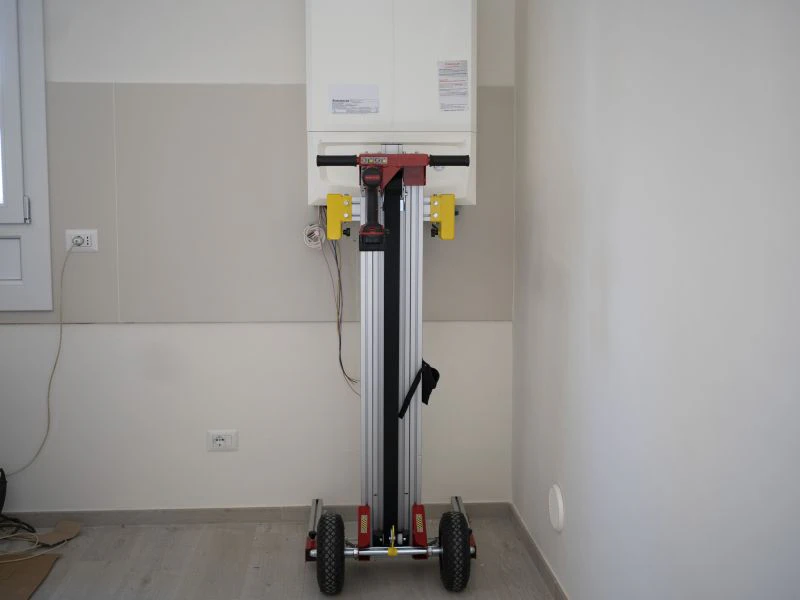
For Air Conditioning, Boilers, and MEP Systems HVAC and mechanical contractors need a compact, stable, and easily maneuverable lift. Here, the lift assists operators in elevating indoor/outdoor units, boilers, or technical components to height, reducing physical effort and enhancing installation safety. Golia’s manual lift lines are engineered specifically for installers operating in tight quarters requiring precise placement.
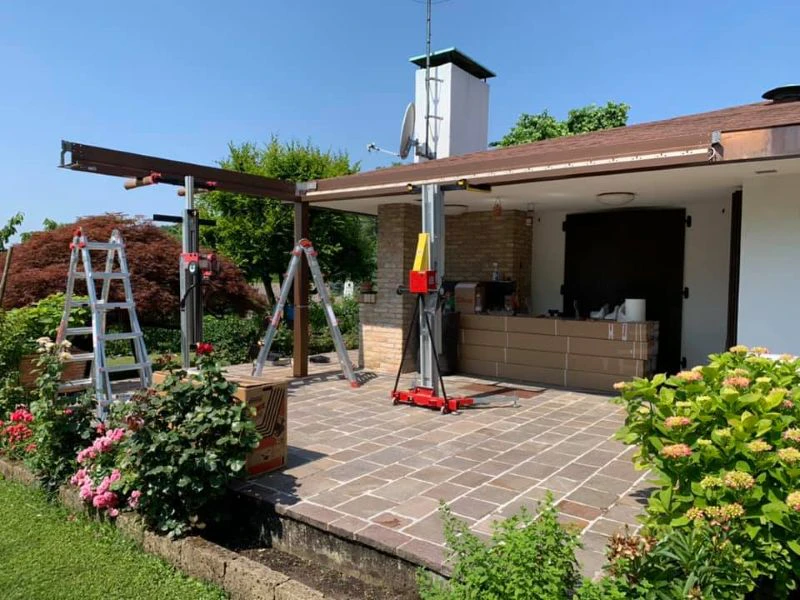
For Awnings, Pergolas, and Light Structures When mounting awnings, pergolas, or light structures, controlling the load during elevation and keeping it steady during fastening is essential. A manual lift simplifies workflow and reduces the need for multiple workers holding the load simultaneously. Height reach, stability, and mobility are decisive factors here.
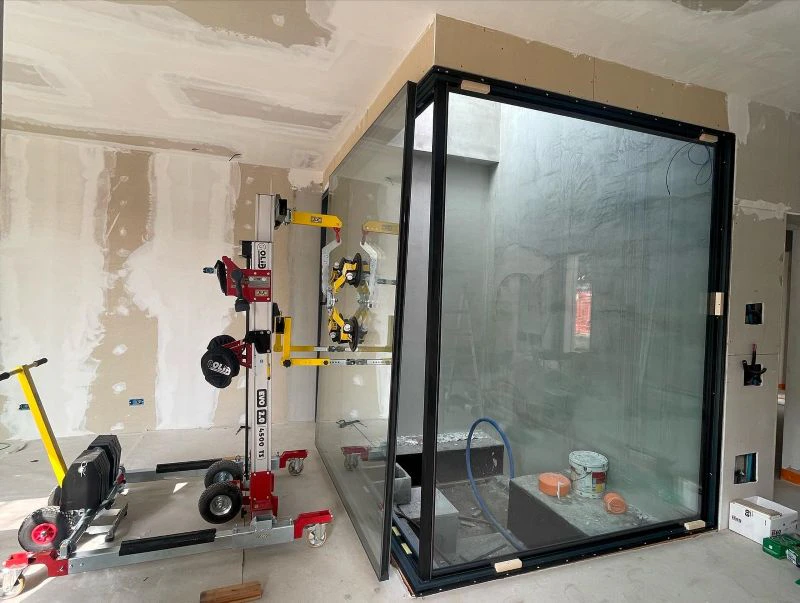
For Glass and Window Installation Handling glass units and windows requires specialized equipment capable of ensuring safety, accuracy, and absolute control. It is important to select lifts specifically engineered for installing glass panes, shopfronts, and large window frames. Golia offers a dedicated line of glass and window lifting equipment designed for transportation, lifting, and on-site positioning. When loads are fragile, heavy, or bulky, generic tools are inadequate—a dedicated unit is required.
For Workshop and Industrial Environments In artisanal workshops and industrial sites, manual material lifts are used for moving goods, components, tooling, and materials. Selection factors include usage frequency, average load weight, space constraints, and transit between departments or storage areas. A professional model ensures continuous uptime and avoids downtime caused by inadequate equipment.
Mistakes to Avoid When Selecting a Manual Material Lift Selecting the wrong equipment negatively impacts project timing, safety, and work quality. Common pitfalls include:
Buying a model with insufficient capacity, or conversely, selecting an excessive capacity that adds unnecessary cost, weight, and transport complexity;
Overlooking the required maximum lifting height;
Underestimating transport dimensions and vehicle fit;
Choosing a lift unsuitable for the specific load type;
Focusing exclusively on the initial purchase price;
Neglecting the availability of accessories, spare parts, and technical support;
Using generic equipment for specialized trade applications.
A professional manual material lift is not just a tool—it is an integral part of your workflow. It should be selected with the same rigor as any core technical tool in your business.
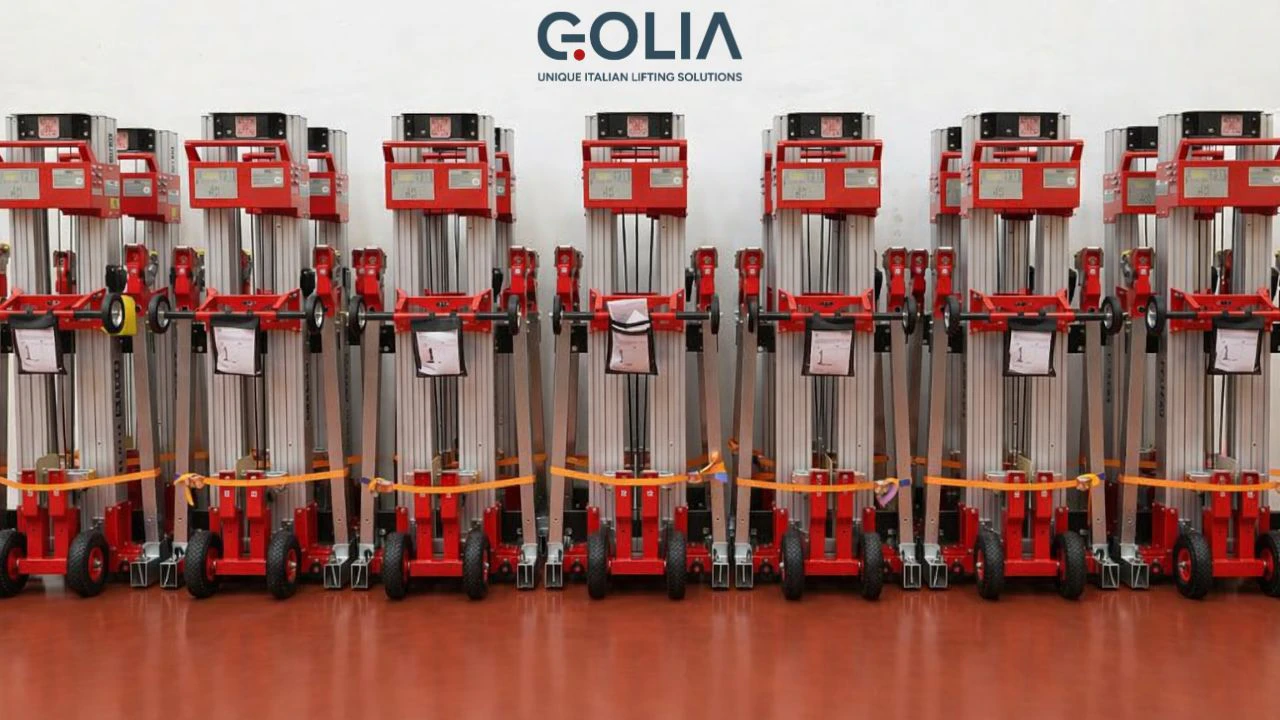
Why Choose a Golia Manual Material Lift? Golia material lifts are engineered to meet the concrete needs of professionals who lift, transport, and position heavy loads daily in safe conditions.
The lineup covers various trades: from HVAC and boiler lifting to awning/pergola installation and specialized glass handling.
Key strengths of Golia lifts include:
Heavy-duty build quality designed for professional use;
Compact, highly portable designs;
Strong focus on operator safety;
Smooth maneuverability;
Models tailored to diverse heights and load capacities;
Versatile application options;
Made in Italy manufacturing excellence.
Choosing Golia ensures reliance on trusted equipment that boosts jobsite efficiency and simplifies heavy lifting in challenging environments.
How to Identify the Most Suitable Golia Model To select the ideal manual lift, consider these practical questions:
What type of load will I be lifting?
What is the maximum weight required?
What maximum height do I need to reach?
Do I work primarily indoors, outdoors, or on active jobsites?
Do I require an ultra-compact, easily transportable model?
Is the load fragile, bulky, or requiring specialized accessories?
How frequently will the lift be used weekly?
Answering these questions points directly to the right configuration, avoiding unsuitable purchases. Golia offers specialized product lines to provide every professional with a tailored tool for daily operations.
Frequently Asked Questions (FAQ) What is the best professional manual material lift? The best lift is one correctly sized for your specific load weights, reach heights, and operating environments. For installers, glaziers, and technicians, key features include robustness, stability, portability, and heavy-duty durability.
Can a manual material lift be used for installing air conditioners? Yes, professional manual lifts are ideal for installing air conditioning units, boilers, and MEP components. They enable smooth, controlled elevation and eliminate physical strain during final positioning.
Which lift should be used for glass and window installation? For glass and window installation, use a lift specifically designed for glazing applications. Glass and window frames demand high stability, fine control, and dedicated glass-handling attachments.
How critical is load capacity when selecting a lift? Load capacity is a primary factor. Choose a model that covers your maximum expected weight with a comfortable safety margin for optimal operational safety.
Why choose a professional manual material lift over a budget alternative? Professional equipment guarantees higher safety standards, durability, stability, and positioning precision. In daily use, these qualities directly enhance work quality, reduce task duration, and protect worker safety.
Investing in a professional manual material lift means investing in safety, operational efficiency, and overall work quality. Load capacity, reach height, stability, maneuverability, and compact footprint are the core parameters to evaluate. Explore the complete range of Golia manual material lifts or contact our team to select the perfect solution for your daily operations.